The Mountain (Which Mountain?)
He longs for the one line to give them that they will always remember, that will embrace everything, that will point the way, but he cannot find the line, he cannot recognise it.
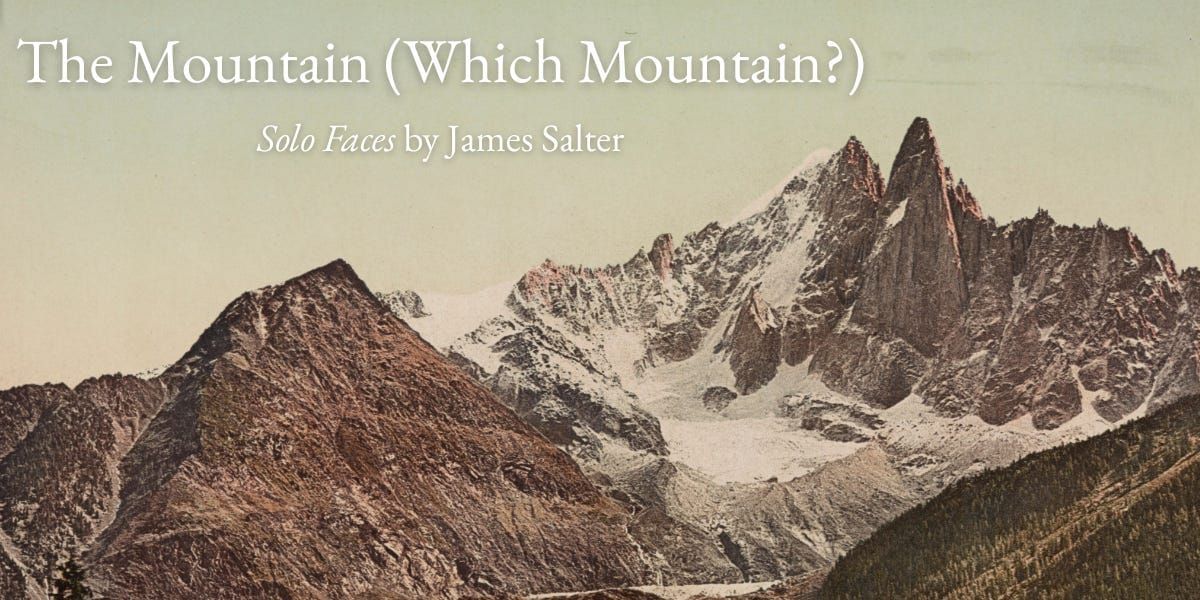
Writing, Ambition, and Solo Faces by James Salter
I
In the week that I was packing up my flat in Oxford, a friend invited me to dinner with a renowned non-fiction writer and his husband, an academic in the social sciences. I admired both of them very much – the latter because he’d been very kind to me when I’d met him a few years ago, and because he was wonderfully well-read and had introduced me to the work of Françoise Sagan – and the former, mainly because of his reputation, as I’d read almost nothing of his work. I planned to correct this defect in the days before the dinner. Unfortunately, Blackwells didn’t have a copy of his latest book – not because they hadn’t stocked it but because it was sold out – and so I showed up with only the vaguest idea of what he wrote about: it was largely ‘historical;’ it focussed on ‘social issues.’
Unsurprisingly, he was as well-read as his husband, if not more so, and so I spent most of the evening trying not to let on how few acknowledgments pages I had ever reached. Most of the conversations began in the form: ‘Have you read…’ I quickly realised that the thing to do was to ask the question, rather than be in the position of answering it, since, in the latter case, my answer would almost invariably be ‘No,’ causing the conversation to stutter as one of them tried that impossible task of conveying the contents of a book which another person hasn’t had the experience of reading; whereas, when I did the asking, the answer would usually be ‘Yes,’ which produced an excited rustle around the table, an anticipation that, now, a proper conversation could be had.
I don’t know how I expected him – the non-fiction writer, let’s call him Sam – to sound, but my impression of him centred on his voice, which was gentle and low. Combined with the things this voice said, and the fact that Sam was bald, made me feel that he was a kind of Zen monk, a modern day Bodhidharma, and that if I could only ask the right questions, and listen carefully enough to the answers, then he could give me all the secrets to writing, to life; that, as Thomas Wolfe would say, he had found the lost-lane end into heaven. (I am always looking towards people and books to give me such secrets; I think, in a way, anyone that reads seriously is doing that – to believe that there is one book, one passage, one line, the proper apprehension of which will end all personal suffering. As James Salter writes of Viri in Light Years, when he reads to his daughters:
He longs for the one line to give them that they will always remember, that will embrace everything, that will point the way, but he cannot find the line, he cannot recognise it. It is more precious, he knows, than anything else they might own, but he does not have it … The best education comes from knowing only one book, he tells Nedra. Purity comes from that, and proportion, and the comfort of always having an example close at hand.
‘Which book?’ she says.
‘There are a number of them.’
‘Viri,’ she says, ‘it’s a charming idea.’
I think many of us are like Viri).
Sam had, of course, been informed by someone – my friend, or his own husband, or both – that I, too, was a writer. I was embarrassed about this – that somebody had, in conversation with him, used the same noun to describe what I did as was used to describe his profession; suggesting that my attempts to write a novel were somehow in the same phylum as his many published, award-winning, lauded, excellent books (having not read them, I imagined them as incomparably excellent). I would’ve been more comfortable if he’d been told that I was a ‘scribbler’ or, perhaps, a ‘jotter.’
But because he’d been told I was a ‘writer’ – I had the sense that things were being arranged to ‘do me good’ – I ended up talking alone with him in the galley kitchen, with me at the exit-end and him at the sink-end, and I had the fear that I was trapping him in, that he would like nothing less than to speak to a young ‘writer’ about ‘writing,’ having, no doubt, been made to do just that many times in the past by well-meaning friends and family members, and therefore having been victim to any number of insufferable bores. The whole time I was thinking about a passage in Fitzgerald’s 'Early Success,' in which he describes – having just published This Side of Paradise – a man called Mr. A paying him a house visit. His father admits ‘Mr. A’, and Fitzgerald is under the impression that ‘Mr. A’ is a newspaper owner, but:
Within two minutes I myself was in some confusion to what Mr. A was. There stood my first anonymous admirer, one who had not even read my book, and far from being a newspaper owner, he was a full-time horror, one who devoted himself to the business of being a horror with single-mindedness and concentration. His person was a continuous slither, of eye, of tongue, of sliding hand and mincing foot. He twittered with a coy and horrible excitement. He said he had written poetry, and he made the fact of writing at all somehow shameful and obscene. For many years he was what I half expected to meet when an admirer impinged on the home.
The phrase ‘of sliding hand and mincing foot’ – why that phrase, and not ‘full-time horror’ or ‘shameful and obscene,’ I have no idea – kept pinging around my mind, and while I rested my forearm on the counter, I tried very hard to keep all my limbs and appendages still. But, if Sam did think I was a Mr. A, he kept that to himself. He asked me how my book was going, and I told him – eager to complain to someone who would understand – that I was now rewriting it for the fourth time. He nodded in a way that suggested he understood perfectly. After a pause, I said something like: ‘Does it ever get any easier?’
He laughed, snuffled – he had a cold – and shook his head. 'No, no – I’m afraid not. J.M. Coetzee has a great quote about it, though. He says you have "to be like Atlas, holding up a whole world on your shoulders, and supporting it there for months and years while its affinities work themselves out." It’s a great line, but, for me, writing is often joyful. I don’t get the sense that it is for Coetzee.’
I didn’t quite know what to do with myself – I performed a mental search for related quotes but more or less ran dry, and confusing Atlas’s holding up the world with holding up a mountain, landed up saying:
‘Ah, mountains. There are lots of good quotes from writers about mountains. I often think about this one from Neil Gaiman. He said that when he was trying to break in as a novelist, and he was working at a newspaper, he imagined that being a full time novelist was this mountain, and that he would only make decisions which took him closer to the mountain, not further away.’
The actual Gaiman quote, from a commencement speech in 2012, is:
Something that worked for me was imagining that where I wanted to be — an author, primarily of fiction, making good books, making good comics and supporting myself through my words — was a mountain. A distant mountain. My goal. And I knew that as long as I kept walking towards the mountain I would be all right. And when I truly was not sure what to do, I could stop, and think about whether it was taking me towards or away from the mountain. I said no to editorial jobs on magazines, proper jobs that would have paid proper money because I knew that, attractive though they were, for me they would have been walking away from the mountain. And if those job offers had come along earlier I might have taken them, because they still would have been closer to the mountain than I was at the time.
As a result of my misunderstanding in that conversation, I now associated this Gaiman quote with the Coetzee one, and when I left dinner, I continued to imagine the Atlas figure holding up a mountain, rather than the world. Perhaps this also has something to do with being from Cape Town.
Mountains occupy a prominent place in the psychology of everyone who has lived in Cape Town. You simply cannot go away from them, Table Mountain especially – which is the most clichéd of all symbols of Cape Town – the way its ruled line dominates the landscape; all the times you are told by Conde Nast magazine and tourists about just howbeautiful it is (and it is, indeed beautiful, if you can manage to actually see it through everything that has been said about it); the fine-line tattoos that people have of it on their forearms – and if not Table Mountain, then Devil’s Peak, or Lion’s Head (or Laan’s Head as it is often pronounced by locals, and mockingly of those locals by other locals). For me, mountains had therefore become a kind of metaphor for homesickness, because my first year in England had been spent in Norwich, which is so utterly, completely, thoroughly denuded of mountains that I know someone who wrote a short story about precisely this, about a boy who looks for the tallest peak in Norfolk, finds it, and hikes it in less than twenty minutes. I also thought that it was dignified to miss seeing mountains, because I grew up on Lord of the Rings, and for some reason, the line that I’ve always remembered best is Bilbo’s: ‘I want to see mountains again, Gandalf, mountains.’
Anyway, because of all this – perhaps in an effort to prove my claim to Sam that mountains make for good metaphors about writing – once I got back to my girlfriend’s aunt and uncle’s house where we staying, I immediately started another Salter novel, Solo Faces . What I knew going into it was that it was about a mountaineer, and, intuiting from the introduction by Nick Cave which I had skimmed, that the act of climbing the mountain was going to be a glorious and perfectly apt symbol for something – for precisely what, I could not say.
II
What, exactly, do the many mountains in Solo Faces symbolise? Shortly after arriving in France, speaking almost no French, Rand describes his first vision of Mont Blanc thus:
The lights of the oncoming cars began to appear, a sulfur yellow. The rain had ceased. The mountains lay hidden in a kind of smoke. It seemed as if the stage were being set and then suddenly, at Sallanches, the valley opened. There, at its end, unexpected, bathed in light, was the great peak of Europe, Mont Blanc. It was larger than one could imagine, and closer, covered in snow. That first immense image changed his life. It seemed to drown him, to rise with an infinite slowness like a wave above his head. There was nothing that could stand against it, nothing that could survive. Through crowded terminals, cities, rain, he had carried certain hopes and expectations, vague but thrilling. He was dozing on them like baggage, numbed by the journey, and then, at a certain moment, the clouds had parted to reveal in brilliant light the symbol of it all. His heart was beating in a strange, insistent way, as if he were fleeing, as if he had committed a crime.
Gorgeous, no doubt, but the ‘symbol of it all’ – all what? At first, the act of climbing a mountain does seem to be a stand-in for greatness. But when Rand and Cabot summit their first great peak, the Dru, for which they have prepared for months, and for which Salter has prepared us, the reader, across many chapters – the whole novel has been building up to this point at 80-odd pages in – when they finally get the top, Salter rewards us, and them, with only this:
A final overhang, the last rope-lengths, and they were there. It was nearly noon. Green valleys, glaciers shone below. They were above all but the highest peaks. They stood in silence, too deeply moved to speak. The bivouac spot at the base seemed weeks, even years behind. They still had to descend into a notch and climb some more to go down, but that was not important. The West Face was below them.
Cabot surged ahead. He led the way. He was moving quickly, almost with too much haste, especially on rappels – descent by means of the rope. Descending is always dangerous, the worst seems over.
‘What’s the rush?’ Rand reached out to hold him back.
‘Let go.’
‘You’re kicking stuff down.’
‘Stop worrying,’ was all he said.
And that is all Salter said, the full achievement of 80-odd pages of effort. The great Dru has been submitted, and Cabot – who nearly gave his life for the ascent – cannot wait to get back down. Salter denies himself too – from indulging in the pleasure of producing rolling mountains (no pun intended) of prose which we might expect from him, and for which we would, after all that effort, forgive him.
Solo Faces begs to be read as a myth, a fable, a parable. Sometimes, it seems an Icarus tale, a critique of the pursuit of greatness. Rand’s most recurrent longings are for the simple life, for the ebb and flow and routine of family and regular employment. But it is not so simple as that – with Salter, it is never so simple as that. Many of the most beautiful passages in the novel are those in which Rand extols the virtues of his success, the physicality of his success.
After the Dru, Rand lives like monk, out in the trees, in a tent, summiting peak after peak:
His ambitions had been ordinary, but after the Dru it was different. A great, an indestructible happiness filled him. He had found his life.
The back streets of town were his, the upper meadows, the airy peaks. It was the year when everything beckons, when one is finally loved. The newspaper clippings were folded and put away. He pretended to scorn them. He kept them despite himself. The true form of legend, he believed, was spoken. He did not want to be catalogued, he said, read and discarded like sports scores and crimes.
And:
It was morning as they sat there, the light still new. Unknown sentinels stood distant, pale. He could have them, he had only to go forth. He was like the sun, touching remote peaks, they awoke to his presence. The thought of it made him reckless. He felt an immense strength. He saw an immortal image of himself high among the ridges – he was willing to die to achieve it.
Perhaps we could say that, at least in Rand’s case, both positions are true: the total, almost insane dedication to his task, is a wellspring of meaning, of joy, but that, also, this dedication makes a simple, more sustainable form of happiness, unattainable. Both can be the good, but in both we long for the other – we must not be fooled into thinking, if we choose the first path, that our victories will always be non-pyrrhic, but also that, if we choose the second, we must not be taken in by the rhetoric of non-trying, because, sometimes, the great path can be worth it.
Except, in this sense, Solo Faces does become a parable – because who of us, truly, sets out towards greatness – not in the trivial sense of watching a motivational video on Youtube where a man screams madly at us to be a lion, not a gazelle, and allowing ourselves to be consequently bullied into the pursuit of making lots of money – but in the sense of trying to cure cancer, being the first to hike K2 alone, write a play superior to Hamlet? Very few of us, I would wager. Most of our ambitions – at least the ones we dare admit – are less complicated: run a marathon, lose five pounds, buy a house, get married, make a living doing something we like, or, simply, make a living.
But I don’t think that what Salter is getting at is as simple as ambition, as wanting to be great. Rand’s ambition is only a stand-in for something else – and chosen as a stand-in, because there are so few modes of living which require a total commitment to anything. If Salter had written Solo Faces in the 17th century, it could’ve been about a man who becomes a Franciscan monk. But writing in modern America – Solo Faces was published in 1979 – in a society largely un-godded by a second World War in which Salter served as lieutenant (he also served in the Korean War and is credited with a MiG-15 victory as well as more than 100 combat flight missions) – a novel about a Franciscan monk would have been absurd. Nevertheless, we are closer to the truth of Solo Faces in thinking about Rand as a monk than as Jordan Belfort.
That ‘something else’ for which ambition and greatness stands is another set of longings, more private, and less easy to describe. The desire, as Wolfe puts it in Look Homeward Angel, for:
a stone, a leaf, an unfound door … Remembering speechlessly we seek the great forgotten language, the lost lane-end into heaven, a stone, a leaf, an unfound door.
Or as Wolfe has Eugene’s sister, Helen, imagine it in his second novel, Of Time and the River:
And suddenly, with a feeling of terrible revelation, she saw the strangeness and mystery of man’s life; she felt about her in the darkness the presence of ten thousand people, each lying in his bed, naked and lone, united at the heart of night and darkness, and listening, as she, to the sounds of silence and of sleep. And suddenly, it seemed to her that she knew all these lonely, strange, and unknown watchers of the night, that she was speaking to them, and they to her, across the fields of sleep, as they had never spoken before, that she knew men now in all their dark and naked loneliness, without falseness and pretence as she had never known them. And it seemed to her that if men would only listen in the darkness, and send the language of their naked lonely spirits across the silence of the night, all of the error, falseness and confusion of their lives would vanish; they would no longer be strangers, and each would find the life he sought and never yet had found.
‘If we only could!’ she thought. ‘If we only could.’
(This is the essential Wolfe – with the person conceived always as a stranger, to themselves, to everyone else, groping blindly towards something that they never quite grasp).
This is sort of longing which we are meant to attribute to Rand, far more than any of his expressed desires towards greatness, fame. It’s easy to imagine his desire to summit one peak, and then another, and another, to be much like Viri’s desire in Light Years for the single line or the single book – Rand believes that there is one mountain, one climb, just as, I think, many of us believe that there is one action, one new way of thinking which might solve everything.
For me, this is what reading is, what writing is – a search for a singular enlightenment that never quite comes.
III
Solo Faces ends with Rand returning to California, which is where the prologue began. Reading this, when I did, I couldn’t help feeling a similar sense of circularity: the house that I was staying at – my girlfriend’s aunt and uncle’s – was the first place I had stayed in Oxford when I had moved three years before; and Sam’s husband, was one of the first people I had met in Oxford when I visited the city six years before. I had not seen him again until that dinner. Like Rand, I was about to begin a series of trips which would culminate in moving home – in my case, back to Cape Town, where I’d lived until I was twenty-two. Unlike Rand, however, I did not feel that I had gone as far as I could. Whatever it was I’d been looking for in England, I hadn’t quite found – in those three years, I’d spent most of my time and energy writing and rewriting a novel for which I was unable to find an agent. I was coming back with no clear technical skills, no job lined up. Mostly, I felt that I had been a pretty irresponsible caretaker of my own future. (If I want to introduce something with this essay it is, perhaps, my desire to go on looking.)
Once back in California, the narrative flushes forward. Rand has become a truck driver; he lives anonymously. It is not clear that he ever finds, in a simpler life, what he was looking for. The final lines read:
He sees it there in the darkness, not a vision, not a sign, but a genuine shelter if he can only reach it. In the lighted room are figures, he sees them clearly, sometimes seated together, sometimes moving, a man and a woman visible through the window, in the dusk, the Florida rain.
If Solo Faces has a central argument, it is close to one of the most recurrent in Proust – that the dream is always better than reality; once the dream enters into reality, it is crushed, we are cheated out of it – but with a variation: that sometimes, only sometimes, reality coincides with the dream.