1. CORPORATE ANTHROPOLOGY
U., the narrator of Satin Island, is gainfully employed as a ‘corporate anthropologist.’ What the hell is a ‘corporate anthropologist’?
The world Tom McCarthy describes – set in a dystopian alternate present, though, since it was written in 2015, it is, to us, an alternate recent past, as the characters still use Skype – has become so deluged with signs, symbols, and information that it is necessary for corporations to employ people like U. for the purpose of creating meaning.
Given that Satin Island was written in 2015, this is pretty prescient stuff.
While, back then, the idea of humanities academics being employed to do humanities academic work in corporations would’ve seemed like speculative fiction – or perhaps the soul-selling fantasy of arts grads fed up with the low pay of arts jobs – this is increasingly becoming, if not common, then at least a thing. Much has been made, for example, of Anthropic’s decision to employ a couple of philosophers.
But the crisis of meaning McCarthy envisions has, in many ways, been going on for a long long time – it’s hard to say where exactly it starts, whether with the internet, access to international TV news stations, or globalisation in general. Perhaps it can even be connected, as most of history is in some vague way, to the agricultural revolution.
It’s the same crisis Knausgaard describes in my favourite essay, ‘Idiots of the Cosmos,’ though he interprets the issue through place (it’s interesting that place is the most common metaphor for both time and the digital). He argues that with everything shown, the same images and voices and events made accessible from anywhere in the world, the difference between places – perhaps even the concept of difference – collapses.
Like most cultural events, this is the sort of ‘crisis’ which doesn’t have a clear name and which is spoken about in different fields in different ways, though is perhaps best summed up by the film title, Everything Everywhere All at Once.
Now, this isn’t only to do with the internet – which is, of course, a big part of it – but the idea of a meaning-crisis has gained much currency in the last year or two as being concerned with algorithms, with AI, with SLOP. Strangely, however, the field most interested in McCarthy’s world is, of all places, brand.
What gives a great sense of how U.’s job is supposed to work is looking at the website of the brand strategist, Eugene Healey. His homepage appears as a swirling white-on-black mess of letters, with the exhortation to: ‘Click to make sense of the algorithmic soup.’
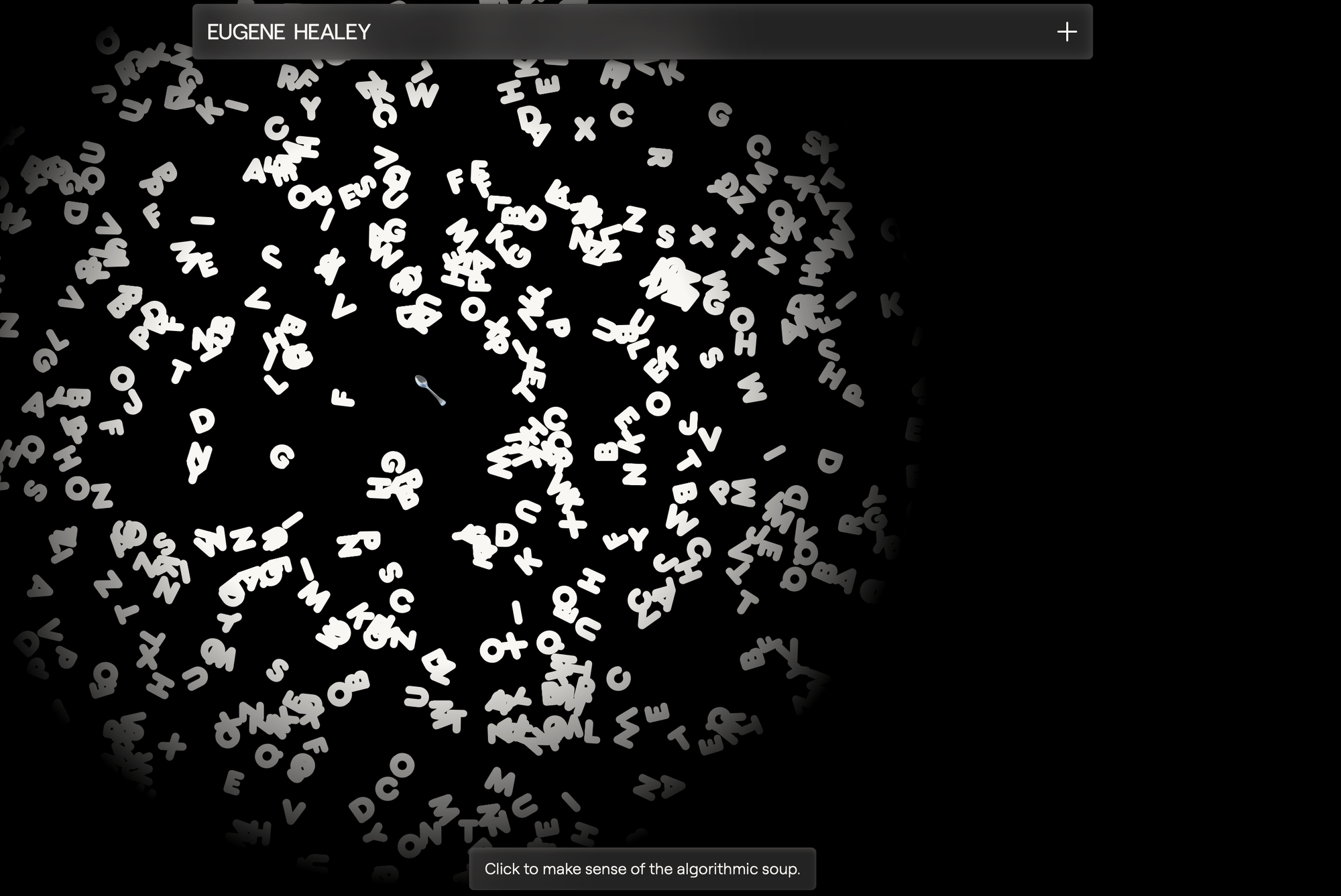
When you do, the letters form themselves into branding proverbs like: ‘The algorithm eats aesthetics for breakfast;’ ‘Modern brands are mosaics not stories;’ ‘All that is solid melts into content.’
It’s a great website concept, a sort of typographic ekphrasis. But there’s something quite funny about the fact that, by necessity – since the alternative of using some generative AI to produce phrases would totally undercut the message – the number of phrases the page can produce is limited.
I.e., in the functionally infinite, ever expanding stew of signs, the number of meanings we can produce is finite. (And, of course, they aren’t produced, as such, but were presumably written by Healey beforehand).
Or, another example of brand strategy’s take on the issue comes from the Office of Applied Strategy. They’re a kind of humanities-ish think-tank thing, based in New York, boasting clients like Nike and Netflix. They’re most known for their forecasting reports, regarded by many as best-in-class, which trade in an entertaining kind of pop-culture futurism.
But their most recent offering, hilariously, is a speculative fiction anthology called Counterfictional Futures, which explores the effects of technology (mainly machine learning, I think).
Now, I haven’t read it, I have no idea if it’s any good – though I was amused by how their Instagram announcement cited ‘corporate espionage’ as a source of material – but what’s more interesting to me than any of the stories, is the fact that the anthology exists at all.
The digital economy has become so deluged that now fiction is being asked, by real big multinational corporations, to make sense of it.
This newsletter is free to read. It remains so because a small group of awesome readers choose to support it.
2. THE GREAT REPORT
While U.’s job encompasses several vague responsibilities – when the novel begins, many are related to the magnificently vague ‘Koob-Sassen project’ which promises to seep into almost every area of almost everyone’s life, and about which, U., of course, can’t tell us because he’s signed an NDA – his main job, the thing he was actually hired for, by his boss ‘Peyman,’ is to write The Great Report.
What is ‘The Great Report?’
Well, it’s The Book, the thing which will make everything make sense. What does it include? Well, perhaps, everything; or, a kind of Schrödinger’s everything, because everything might, possibly, maybe, end up a part of it. It’s impossible to say. U. doesn’t know. He keeps dossiers on the most disparate subjects in preparation, though his favourites seem to be oil spills and parachute accidents.
These two subjects are homed-in-on, I assume, because they represent both everything and nothing. The oil spill, as he describes it, is totalising – blackening waves and rocks and penguins. On the day he sees a news report of a particularly large spill, he spends so many hours watching videos of it that he gets a kind of Tetris Effect – his thoughts are oil, his dreams are oil, the world is oil.
With the parachutists, he is concerned with their fall into space, into nothingness.
The overall idea here seems to me a riff on the Zen-Buddhist concept of the Empty-Infinite – if everything is overlayed upon everything, everywhere, all at the same time and in all time, then none of it means anything. But McCarthy also seems to ask, in a way, whether not anything is the same as nothing.
3. WHAT’S A NOVEL-ESSAY?
I used a word just now which might be Satin Island’s whole shtick. That word is totalising.
The scholarly interest in Satin Island has been, in large part, because of its form. That form, so it is argued, is the ‘novel-essay.’ (Or, as some have tried to distinguish it more specifically, the ‘fragmentary novel-essay’ because of how the text is written in numbered blocks, which on the one hand, McCarthy has called ‘Wittgenstein-style;’ and, on the other, is reminiscent of the kind of corporate report which Peyman’s company excels at producing.)
As the name suggests, the novel-essay combines elements of both novel and essay, forging a new one which contains both narrative and discursive elements, i.e., it both tells a story and also discusses things. For example, U. is telling us the story of a kind of office drama, whilst also making arguments about anthropology, in which he draws from the writings of Levi-Strauss and Malinowski.
But one of the most interesting parts about this fusion-form, is what it means for reach and completeness.
An essay, it is argued by people who know about essays, is always, in a sense, provisional. It doesn’t proclaim absolute truth, but offers a space in which truth is worked out, meandered around. Or, we could say – because a huge part of essay-writing consists in creating the appearance of spontaneity – an essay offers a way of representing the space in which truth is worked out.
But an essay is usually short – a few pages, not book length. Traditionally, it is confined to a single, discrete subject, it is ‘on’ something – on beauty, on truth, on reading, etc. (Although, it does, of course, pursue tangents, slip lithely from one issue to another). An essay does not try to swallow the world and it does not claim the final word.
A novel is the opposite. A novel is capacious, far-reaching, consisting of hundreds or even thousands of pages. The whole point of the novel as technology – and that might seem a funny thing to say, but a novel is technology – is to create a kind of virtual reality. It swallows a world, or it tries to invent one. Or, at least, in the tradition of modernist novels, it swallows one person’s interior world. The novel is also forgiving. Since it is so big, you can throw in, really, any detail, any scene – without ruining the whole (or it seems that way).
And yet, the contradiction of the novel, especially in Western storytelling traditions, is that it has to be finished. The plot has to be 'wrapped up’ by tying together all of the individual ‘narrative threads’ – as many as possible, anyway. Put simply, the story must be ‘resolved.’ This is the traditional expectation (though, of course, it has been challenged by many novels in many ways).
So, what happens when we take the small provisional thing and mix it with the big finished thing?
Well, many things can happen; the scholars have several different theories on the ways in which novel and essay can combine.
But one thing which can happen, is that the novel absorbs the essay’s characteristic provisionality and meandering-ness – and with the ability now too, of blending fact and fiction, argument and drama – the novel-essay becomes an almost impossibly large canvas, capable of going anywhere, looking into anything, and all without having to resolve itself.
The Great Report that U. describes would be, perhaps, the ultimate novel-essay – the ur novel-essay – so wide-reaching it might even be the world itself; but, maintaining the traditional characteristic of the novel, here totally impossible, that it resolves.
See you in two weeks,
Blake
Business reports as literature (no. 24)
What the hell is a ‘corporate anthropologist’?